

Date Published: 2nd September 2026
Journal: JMIR Publications
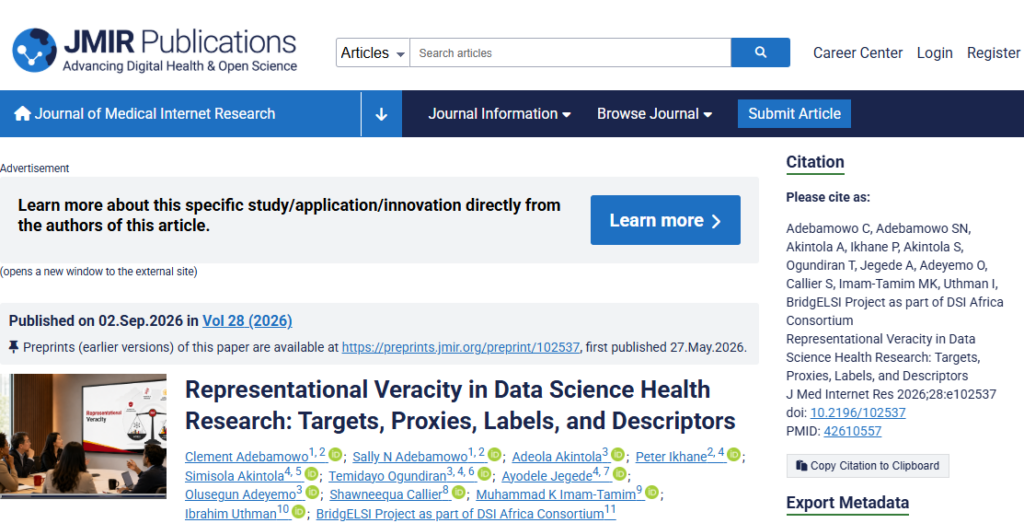
Title: Representational Veracity in Data Science Health Research – Targets, Proxies, Labels, and Descriptors
Link to article:
https://www.jmir.org/2026/1/e102537
This paper introduces representational veracity (RV) as an important consideration for the ethical governance of data science health research. It asks a fundamental question: whether the targets, proxies, labels, classifications, and population descriptors used in health data continue to truthfully and responsibly represent the people, populations, and phenomena they are intended to describe at the point of use.
The paper argues that conventional ethical oversight, which often focuses on privacy, consent, bias, and fairness, may overlook important upstream questions about how people and phenomena are represented in data. It proposes four domains for assessing representational veracity: material provenance, informational descriptors, normative authorization, and relational community. The framework is intended to support researchers, ethics committees, data-access committees, AI governance bodies, regulators, and other oversight actors in identifying representational problems before they translate into downstream harms.
For BridgELSI, this work extends the project’s focus on ethical oversight of data science health research by providing a framework for examining whether the underlying representations on which data-driven and AI systems depend remain ethically and substantively appropriate over time.